Average Reviews:

(More customer reviews)Are you looking to buy Schools for Misrule: Legal Academia and an Overlawyered America? Here is the right place to find the great deals. we can offer discounts of up to 90% on Schools for Misrule: Legal Academia and an Overlawyered America. Check out the link below:
>> Click Here to See Compare Prices and Get the Best Offers
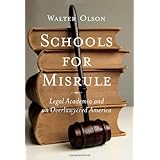
Schools for Misrule: Legal Academia and an Overlawyered America ReviewOf all the possible explanations for Barack Obama, one of the most intriguing is that, like Bill Clinton before him, he was both a law school graduate and a law school professor.As such, Walter Olson explains in his new book, Mr. Obama was subjected to an environment of overwhelming leftism.
Democrats outnumber Republicans 28 to 1 on the Stanford law school faculty, 23 to 1 at Columbia, Mr. Olson reports.
Mr. Olson's book describes the various ways that law schools have shaped public policy. Clinics on the law school campuses get involved in political issues. He writes that Yale's Legislative Advocacy Clinic "attempts to move the state of Connecticut toward 'a more progressive agenda in taxing.'" CUNY law school, meanwhile, is "itself a unit of the same New York City government it regularly sues on welfare issues. The website of Fordham's Community Economic Development clinic says it works to "limit gentrification."
Law schools, including professors who profited personally from their work on anti-tobacco litigation, helped shape changes in product liability law. They also helped spawn "public law litigation" suits under which, Mr. Olson recounts, courts "in more than half the states took control of school financing systems" and "took over control of child welfare departments in thirty-five states, prisons in more than forty, and jails in all fifty..... The process thrust courts deeply into management, with reform orders often going on for hundreds of pages specifying such details as the required square footage of prison cells, the wattage of light bulbs, the temperature at which food had to be served, and so forth."
Mr. Olson quotes one law professor acknowledging that such litigation is meant to "further a decarceration strategy" by making incarceration "both difficult and expensive." The professor has since joined the Obama administration.
Mr. Olson notes drily that "Frequently, many members of the ostensible beneficiary class neither want nor welcome the changes ushered in by court order. Overcrowding suits often result in inmates' transfer from a camped and rundown in-town facility to a more modern but remote facility that is harder for friends and family to visit....In one consent decree, New York City agreed to elaborate new rules restricting its ability to evict disruptive families from its housing projects. But most residents in fact feared the crime spawned by such households, with the result that leaders of the projects' tenant councils wound up hiring lawyers to intervene in the proceedings against their 'own' side."
Mr. Olson, who is a fellow at the Cato Institute and editor of Overlawyered.com, excels at outlining the problems. He's more reticent about possible solutions. He notes that the Ford Foundation had helped to reshape law school curricula and "from 1966 to 1969 contributed start-up funding for Mexican American Legal Defense and Education Fund, the Environmental Defense Fund, the Sierra Club Legal Defense Fund (which changed its name to EarthJustice) and the Natural Resources Defense Council."
So perhaps large-scale philanthropy could have some effect; the book might have mentioned the Olin Foundation's work in spreading Law and Economics to law school campuses. Any donor or foundation wanting to reshape legal education would find Mr. Olson's book a fine place to begin.
In the meantime, the schools are unlikely to reform on their own so long as they have more applicants than they can handle lined up for the chance to pay (or borrow) hefty tuition payments. Never mind that the students may be motivated less by the education provided than by the attendant chances at high-paying law firm jobs in which the students can labor for clients that include the very corporations their professors demonized.
And for all this, the picture may not be entirely as grim as that painted by Mr. Olson with all his usual lucidity and flashes of humor. Justices Alito and Thomas are both Yale Law graduates, after all, while Justice Scalia, a Harvard Law graduate, taught at Stanford and the University of Chicago.
In the meantime, if the law professors are too far to the left, the rest of Americans, while living with the public policy consequences, can at least know that while the law professors have their wins in court, they are often less successful in the court of public opinion. Mr. Obama and Mr. Clinton both managed to get elected, but they were quickly hemmed in by Republican congresses elected after they overreached. In the end, in the American system, the politicians who write the laws, and the voters who put them there, have a way of outranking even the law professors.
Disclosure: The publisher sent a review copy of this book.Schools for Misrule: Legal Academia and an Overlawyered America OverviewFrom Barack Obama (Harvard and Chicago) to Bill and Hillary Clinton (Yale), many of our current national leaders emerged from the rarefied air of the nation's top law schools. The ideas taught there in one generation often shape national policy in the next. The trouble is, Walter Olson reveals in Schools for Misrule, our elite law schools keep churning out ideas that are catastrophically bad for America. From class action lawsuits that promote the right to sue anyone over anything, to court orders mandating the mass release of prison inmates; from the movement for slavery reparations, to court takeovers of school funding—all of these appalling ideas were hatched in legal academia. And the worst is yet to come. A fast-rising movement in law schools demands that sovereignty over U.S. legal disputes be handed over to international law and transnational courts. It is not by coincidence, Olson argues, that these bad ideas all tend to confer more power on the law schools' own graduates. In the overlawyered society that results, they are the ones who become the real rulers.
Want to learn more information about Schools for Misrule: Legal Academia and an Overlawyered America?
>> Click Here to See All Customer Reviews & Ratings Now

0 comments:
Post a Comment