Average Reviews:

(More customer reviews)Are you looking to buy Mixing Minds: The Power of Relationship in Psychoanalysis and Buddhism? Here is the right place to find the great deals. we can offer discounts of up to 90% on Mixing Minds: The Power of Relationship in Psychoanalysis and Buddhism. Check out the link below:
>> Click Here to See Compare Prices and Get the Best Offers
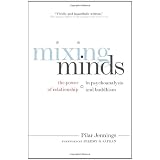
Mixing Minds: The Power of Relationship in Psychoanalysis and Buddhism ReviewSince her unconventional childhood meditating and studying Buddhism, Pilar Jennings brings her professional expertise and personal experience into this rewarding, if challenging, study. Both analyst and analysand, her background in both insight (vipassana) and Tibetan approaches to Buddhism enriches her clinical case studies and psychiatric applications. The result opens up methods where dialogue--and confrontation with the self amidst others in the journey towards psychic healing and spiritual integration--presents advocates of these traditions with possibilities of how they may co-exist more harmoniously. In Buddhism and psychiatry, interpersonal relationships matter most for her.She begins with her own story. Dr. Jennings emphasizes that no mature understanding of psychoanalysis or Buddhism can rely on facile summaries. Her study, grounded in theory but alighting on her everyday life, delves into both approaches. Here a student and teacher, patient and doctor, come together to help the injured recover a sense of wholeness. She favors emptiness, a fundamental dharma concept, as essential. She suggests that counselors open themselves and their clients up to a more playful, open-ended evolution of their psychic encounters into the "pregnant void" where the fluid Buddhist model, of no-self and impermanence, allows more freedom for both the expert provider and the searching supplicant.
Coming to terms with a self which learns not to trust in fixed goals or settled moods may help fragmented Westerners, whether or not Buddhist practitioners, to understand as lived behavior these arcane concepts of "no-self" and "emptiness." About emptiness, she observes "that all phenomena, including healing systems, are empty of inherent meaning and are rather a constant flux of changing causes, circumstances, and conditions. What Buddhism and psychoanalysis are and can provide will mix with the setting, the consciousness, and the unconscious of the practitioner." Her wisdom, as a professional and as a student, a Buddhist and a clinician, appears hard-won, and sometimes easily lost. That is, Dr. Jennings wrestles with the material she teaches here. Fixed answers and pat theories elude her grasp.
Many of her Western Buddhist peers, she cautions, run too rapidly away from psychological healing into spiritual techniques, while these seekers may fail to appreciate the damage they may do when they misinterpret what "no-self" and "emptiness" may truly mean. Jennings skillfully navigates between these Buddhist teachings and psychological inheritances. She sums up basic dharma well, and she contrasts and compares its instructions with Freudian-influenced schools of psychiatry deftly.
However, she refers to Jungian insights into the numinous more in passing; she offers enough to spark curiosity, but then skips away from the resonances that remain. She intervenes, imposes Cartesian limits upon such psychic suppositions as Jung entertained, and she veers off sharply for a hundred pages before mentioning his more open-ended suggestions again. Appearing to favor Freudian-derived responses, Jennings reveals her own preferences, but the appeal of Jung for many Westerners also pursuing Buddhism leaves this fruitful topic underexamined. The relationship of Buddhist-inspired applications to Western analysands from a New Age or Eastern-tinged background, as well as Asians growing up in the global diaspora's modern mindsets, signals a realm for inquiry that Jennings' pioneering work may direct future researchers to investigate.
Spiritual freedom, she muses, may mask unresolved anxieties that the practitioner has fled or masked within the unconscious. The power of the unexamined mental constructs within us, Jennings warns, may be worsened if anger persists but is glossed over or sidestepped. Instead, she suggests, the Buddhist parallel of taking on anger to break it apart--rather than averting one's gaze from it and its effects and its objects--may be the only way to gain a difficult, perhaps endlessly delayed, wholeness that comes from not so much ending anger as coming to terms with its psychic energy and practical impacts.
For desire, as with suffering and with anger, she compares Buddhist responses with those studied by her colleagues. The gap between what one wishes to gain and the mundane knowledge that nothing gained lasts forever represents real life. Dependent origin, the cause-and-effect relationship at the heart of dharma, connects with the student learning from the lama: a model of interdependence rather than self-reliance (taught to Westerners as their assertive, secular ideal ever since the Enlightenment) becomes for Jennings the aspiration better fitted to humbler, spiritually yearning, and psychologically broken people today.
Therefore, Dr. Jennings offers analysts a space where limits of any model can be acknowledged. Rather than grasping one theory, one outcome, one regimen, she urges the pair to shed mental delusions that enlightenment or wholeness precludes a continuation of the psychic struggle. No blissful end of days awaits, for her mind. Jennings cannot accept this entry into detached contentment as a viable, probable, or practical resolution.
By studying the causes of suffering, suffering can be understood. It cannot be escaped or overcome. Instead, how one reacts to suffering proves the solution. Shedding delusion means to grow up and realize that enlightenment may be, for Westerners accustomed to salvific journeys, the only happy ending, and one less free of care than one may expect. For Pilar Jennings, the Buddhist perspective, sharpened over thousands of years, intersects a century of psychological theories and clinical trials and case studies. For the informed analyst, who may increasingly be cognizant of Buddhism among his or her Western patients, and who may even practice it, the augmentation of dharma with analysis serves as a harbinger of the meeting of true minds, as these venerable energies mix and blend.Mixing Minds: The Power of Relationship in Psychoanalysis and Buddhism OverviewMixing Minds explores the interpersonal relationships between psychoanalysts and their patients, and Buddhist teachers and their students. Through the author's own personal journey in both traditions, she sheds light on how these contrasting approaches to wellness affect our most intimate relationships. These dynamic relationships provide us with keen insight into the emotional ups and downs of our lives - from fear and anxiety to love, compassion, and equanimity. Mixing Minds delves into the most intimate of relationships and shows us how these relationships are the key to the realization of our true selves.
Want to learn more information about Mixing Minds: The Power of Relationship in Psychoanalysis and Buddhism?
>> Click Here to See All Customer Reviews & Ratings Now

0 comments:
Post a Comment